browser_* and devtools_* tools that work on the tabs you share from the extension’s dashboard. Nothing leaves your machine: the companion listens on 127.0.0.1 only.
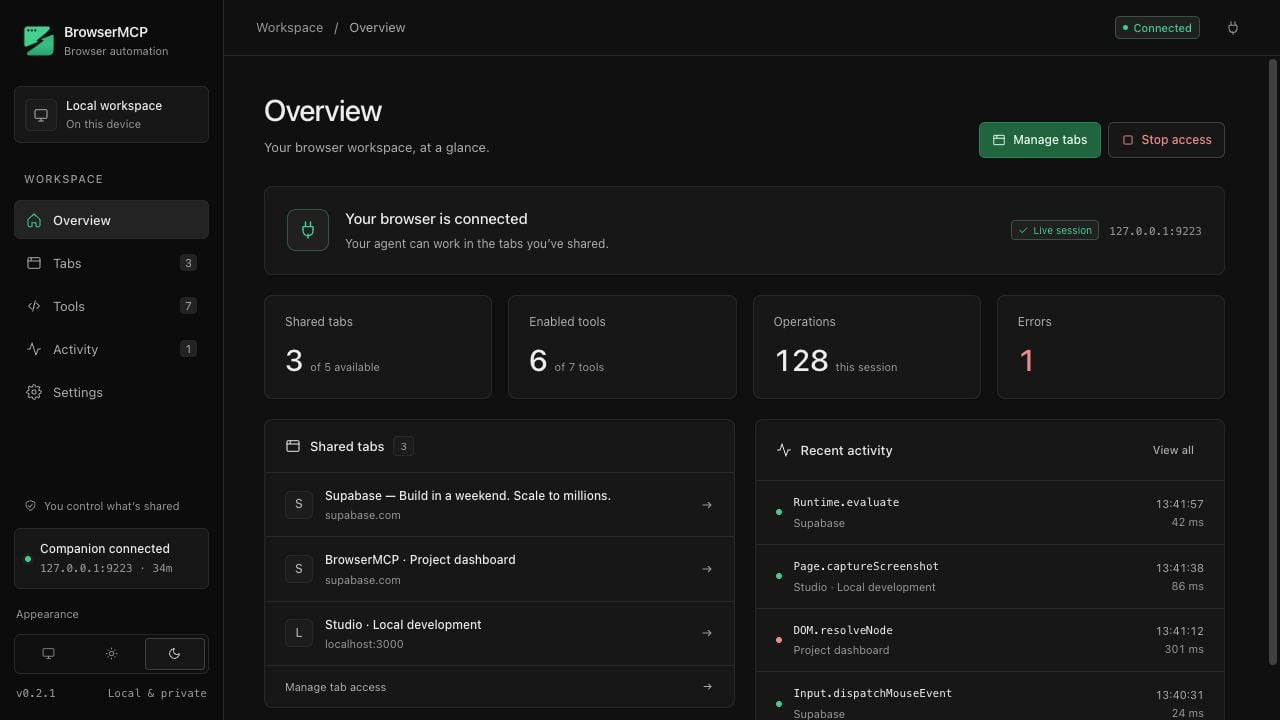
What an agent can do
Operate websites
Navigate, read an accessible snapshot with stable element refs, click, fill, select, upload, press keys, scroll, wait, handle dialogs and take screenshots, all inside tabs that keep your logins.
Read and extract
Turn a page or a URL into clean markdown, pull tables, links and structured records, print to PDF, and call tools that pages expose through WebMCP.
Debug like DevTools
Console, network with mocks and throttling, sources with source maps, breakpoints and stepping, elements and styles, storage, service workers, emulation, accessibility and security.
Profile and audit
Performance traces with Web Vitals, CPU profiles, heap snapshots and leak checks, code coverage, and Lighthouse reports in Chrome’s own file formats.
Two ways to reach a browser
The dashboard decides whether the agent may open a developer browser at all. See Modes.
Where to go next
1
Install
Install the companion and load the extension. Two commands and one Chrome dialog.
2
Connect your agent
Add Browspark to your MCP client, or use the HTTP endpoint for clients that take a URL.
3
Pair and share
Paste the pairing token into the dashboard, share a tab, and ask the agent to open a website.